Is Bitwarden Safe: A Comprehensive Security Review
In the digital age, the safety of our sensitive data is of paramount importance. With this in mind, many individuals and businesses have turned to password managers like Bitwarden to securely store and manage passwords. But the question remains: Is Bitwarden safe? Let's explore this topic in-depth.
Before delving into Bitwarden's security measures, let's first understand what makes a password manager safe. Ideologically, a secure password manager ought to ensure your data's privacy and security, protect against unauthorised access, and provide user-friendly features without compromising your data's integrity.
Bitwarden's End-to-End Encryption
At its core, Bitwarden employs end-to-end encryption, a security practice that ensures only the user can access their data. Bitwarden never has the keys to decrypt your information, adding an extra layer of security.


To illustrate, let's take the example of a user named Alex. When Alex saves their passwords in Bitwarden, the software encrypts the data on Alex's device using their unique encryption key. Bitwarden's servers only receive the encrypted data, ensuring the company can never access Alex's passwords, even with court orders.
Zero-Knowledge Architecture
Bitwarden's zero-knowledge architecture complements its end-to-end encryption. This architectural design ensures that even if an attacker gains access to Bitwarden's servers, they would merely find encrypted data with no practical value.
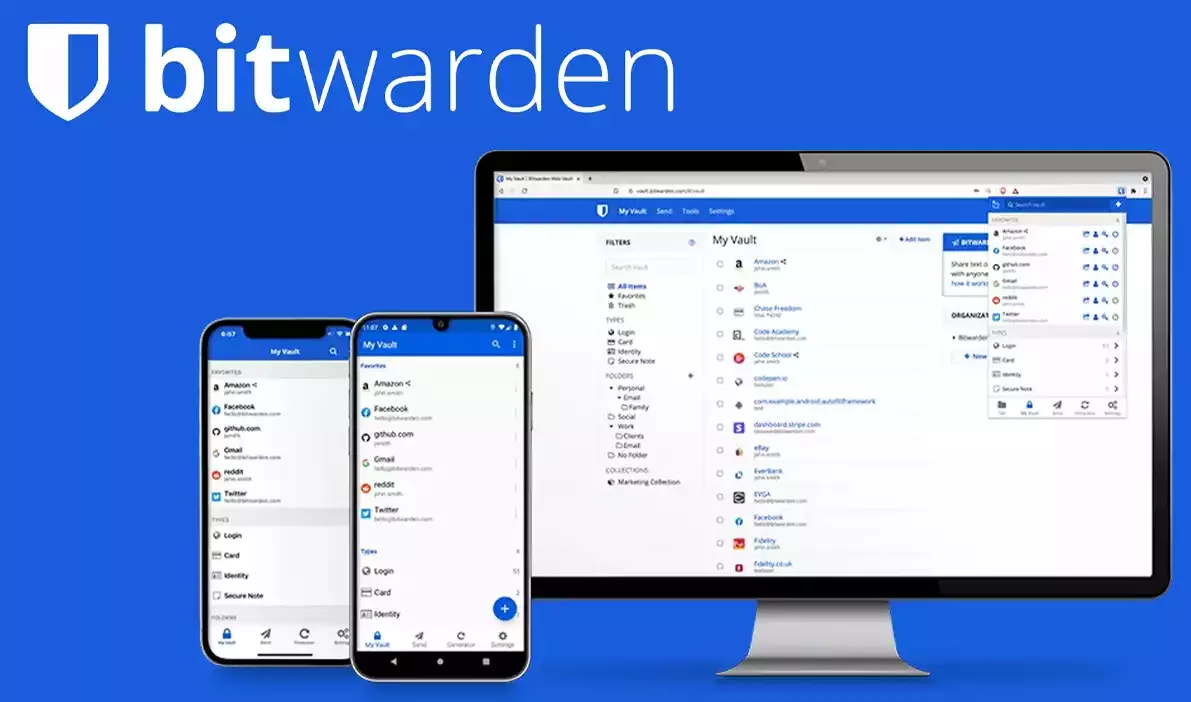


For instance, if Bitwarden faced a breach, the attacker would only find encrypted data, rendering it unusable without the unique decryption keys—keys that only you, the user, hold. This approach is supported by the principle that a password manager should not possess the master password, adding another security buffer.
Bitwarden's Open-Source Codebase and Regular Audits
Open-source codebases provide a unique advantage: they can be independently verified by security researchers worldwide. Bitwarden's open-source codebase allows the public to scrutinise its software, fostering collective wisdom and bug identification.
Furthermore, Bitwarden regularly conducts third-party security audits and penetration tests to identify and rectify potential vulnerabilities. This continuous commitment to cybersecurity ensures that Bitwarden remains robust against emerging threats.


Two-Factor Authentication and Biometric Logins
Adding two-factor authentication (2FA) to your Bitwarden account provides an additional security layer. 2FA ensures that even if a hacker obtains your master password, they cannot enter your Bitwarden account without a second factor.
Moreover, Bitwarden supports biometric logins, which can be more secure and convenient than 2FA in some cases. Biometric logins use a unique physical attribute, like your fingerprint or face, for authentication, adding an extra layer of protection that's virtually impossible to mimic.
In conclusion, Bitwarden's commitment to end-to-end encryption, open-source codebase, regular security audits, and diverse authentication methods indeed makes it one of the safest password managers available today. However, no system is foolproof, and it's essential to maintain diligence in your security practices. Always use strong, unique passwords, and keep your systems and software up-to-date to create a robust security ecosystem.
Related Articles

Fact of Life Series: A Comprehensive Review
The "Fact of Life" series, originally a television show, has transcended its initial medium to permeate contemporary culture, spawning a plethora of memes...

Cardsnacks: Sorting Fact from Fiction - A Comprehensive Review & Complaint Guide
In the dynamic world of card games and snacks, CardSnacks has carved a niche for itself, offering a unique blend of convenience and fun. However, no product is...

Keep Calm and Stay Safe Online: Your Ultimate Internet Security Guide
Navigating the digital world can be as treacherous as it is exciting. With billions of users connected globally, the online sphere presents both unprecedented...

Unveiling The Ex-wife: A Comprehensive Review
The Ex-Wife: A novel you won't want to put down, a wives tale you won't want to miss. This isn't your ordinary breakup narrative; it's an enthralling journey...

Bulk Apothecary: Comprehensive Ratings Review
In the dynamic world of pharmaceutical supplies, the need for quality and convenience has led to the rise of bulk apothecary services. These services, offered...

Is Mini in the Box Reliable: A Comprehensive Review
When you're in the market for a reliable laser level, you might come across the term "is mini in the box reliable?" This question is often raised due to the...