Parts of Speech Blanks Worksheet
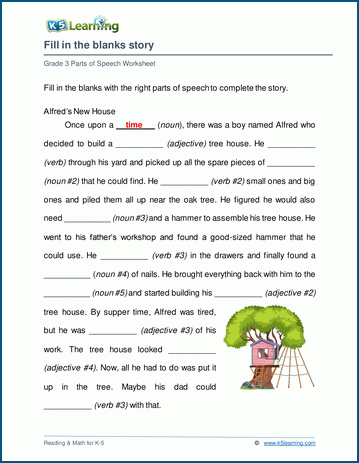
Boost your understanding of grammar with this engaging parts of speech fill in the blanks worksheet. Designed to enhance your language skills, this interactive tool helps you identify and use nouns, verbs, adjectives, adverbs, and other essential parts of speech accurately and confidently. Let's dive in!
Parts of speech, also known as word classes, play a crucial role in communication. They provide meaning and structure to our sentences, making them understandable and engaging for the listener or reader.
The Importance of Parts of Speech
Parts of speech are like the building blocks of language. They help us express our thoughts clearly and effectively, improving our communication skills. By understanding and correctly using parts of speech, we can craft persuasive arguments, paint vivid descriptions, and convey our emotions accurately.


Moreover, knowing parts of speech is vital for learning new languages. It provides a solid foundation for absorbing and applying grammar rules, as well as recognizing and using new words. Let's explore some key parts of speech in the following sections.
Identifying Nouns: The Building Blocks of Sentences
Nouns are words that name people, places, things, or ideas. They can be singular or plural, proper or common. For instance, 'cat' (singular, common) and 'kids' (plural, common) are both nouns. Proper nouns, like 'Paris' and 'Christmas', have capital letters and refer to unique entities.


Here's a fill-in-the-blanks exercise to help you identify nouns: "The __ (1) ran quickly through the __ (2) chasing a __ (3)." The answers are 'dog', 'park', and 'ball', all of which are common nouns.
Verbs: Actions, States, or Occurrences
Verbs express actions, states, or occurrences. They can be regular or irregular, and they often change forms to indicate tense, number, or aspect. Examples include 'run', 'is', 'go', and 'find'. Here's another fill-in-the-blanks exercise to practice with verbs: "She __ (4) to the store after she __ (5) her chores." The answers are 'went' and 'finished'.
Verbs are essential for creating dynamic sentences and conveying a sense of movement and progression. They connect other parts of speech, such as nouns and adjectives, to form meaningful and coherent thoughts.




More Exciting Parts of Speech
Besides nouns and verbs, several other intriguing parts of speech await your exploration. These include adjectives, adverbs, prepositions, conjunctions, and interjections. Each plays a unique role in shaping our sentences and communication styles.
Adjectives, for example, describe or modify nouns and pronouns, providing additional information about their qualities. Adverbs, on the other hand, modify verbs, adjectives, or other adverbs, often indicating manner, time, place, or degree. Prepositions specify the relationship between a noun or pronoun and other words in a sentence.
Adjectives: Describing and Enhancing Meaning
Adjectives offer vivid details and enrich the meaning of our sentences. They can modify a single noun ('the big cat') or a group of nouns ('big cats' and 'black dogs'). Here's a fill-in-the-blanks exercise to help you sharpen your adjective skills: "The __ (6) __ (7) __ (8) cat sat __ (9) the __ (10) table." The answers are 'lazy', 'fluffy', 'black', 'calmly', and 'round'.

Adverbs: Fine-tuning Sentence Details
Adverbs can modify verbs, adjectives, or other adverbs, providing fine-tuned details about actions, states, or other elements. They often answer questions like 'how?', 'when?', 'where?', or 'to what extent?'. Here's an exercise to practice identifying adverbs: "She __ (11) ran __ (12) the park after she __ (13) finished her homework." The answers are 'quickly', 'to', and 'when'.
Now that you've explored parts of speech with engaging fill-in-the-blanks worksheets, why not challenge yourself further? Try creating your sentences with varying parts of speech, experiment with different forms, and watch your language skills blossom. Happy writing!
Related Articles
Parts of Speech Fill in the Blanks: PDF Answers
Whether you're a language student, teacher, or simply aiming to improve your grasp of the English language, understanding parts of speech is a critical step...
Parts of Speech: Fill in the Blanks Guide
Understanding the parts of speech is a critical step in learning and mastering any language. It helps us comprehend the structure of sentences, the...

Fill in the Blanks: Parts of Speech Challenge
Fill in the blanks with suitable parts of speech is a common grammar activity that helps practise and understand the different roles words play in a sentence...

Understanding Parts of Speech: Interactive Fill-in-the-Blank Notes
Understanding the parts of speech is a fundamental aspect of the English language. It not only helps us craft grammatically correct sentences but also adds...

Mastering Reported Speech: Fill in the Blanks
Have you ever struggled to understand reported speech in English? You're not alone. Reported speech, also known as indirect speech or quoted speech, can be a...
Plugging Blanks in Parts of Speech
In the vast landscape of linguistics, one concept that stands out in its importance and utility is that of "parts of speech," often abbreviated as "POS."...