Calculating the Surface Area of a Cut Cone
The surface area of a cut cone, a topic of significant interest in geometry, is a fundamental concept that finds application in various fields, ranging from engineering to organic chemistry. Understanding how to calculate it opens a world of possibilities in problem-solving and spatial visualization.
Imagine you're an architect designing a building with a cone-shaped roof. To efficiently construct and cover this roof, you need to know not just the volume, but also the surface area of the cone. This is where the concept of surface area of a cut cone comes into play.
The Frustum of a Cone
The surface area of a cut cone, or more precisely, the frustum of a cone (the remaining portion when a cone is cut by a plane parallel to its base), is comprised of two circular bases and the lateral surface area. Calculating this accurately is crucial in many engineering and architectural projects.


Before diving into the calculations, let's understand the key variables: R1 and R2 (the radii of the top and bottom circles), and L (the slant height of the frustum).
Lateral Surface Area of a Frustum
The lateral surface area (A_lateral) of a frustum is given by the formula:
A_lateral = π(R1 + R2)L


This formula, derived from the integral calculus, assumes that the cut was made horizontally, resulting in two circular faces and a conical lateral surface.
Area of the Circular Ends
The total area of the two circular ends (A_circles) can be calculated as:
A_circles = π(R1² + R2²)
This simply adds the areas of the top and bottom circular faces together.
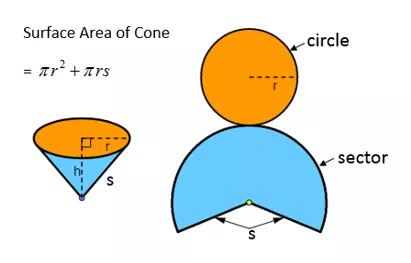


Total Surface Area of a Frustum
Now, let's find the total surface area (A_total) of the frustum by combining the lateral surface area and the area of the circular ends:
A_total = π(R1² + R2²) + π(R1 + R2)L
This gives us a comprehensive understanding of the surface area of a cut cone.
Real World Applications
The total surface area calculation has vast applications. For instance, it can help in calculating the amount of material needed to build a structure, or estimate the quantity of paint required for a project. It also finds significance in fields like chemical engineering, where knowledge of surface area can optimize the efficiency of reactions.
In organic chemistry,Surface area is a crucial aspect in the study of active sites on catalyst molecules. The higher the surface area, the more active sites the catalyst can provide, enhancing its catalytic efficiency.
In conclusion, understanding and calculating the surface area of a cut cone is not just a mathematical exercise, but a skill with tangible benefits across various fields. The next time you look at a cone-shaped structure, whether it's a building, a sports arena, or a molecule, remember the frustum of a cone and the wealth of information its surface area holds.
Related Articles
Calculating Surface Area of a Cone with a Cut-Off Top
The surface area of a cone is a crucial concept in geometry, with numerous applications in fields ranging from architecture to engineering and beyond. One...

"9x9 Cube Surface Area: Calculating Dimensions & Area"
A cube, a three-dimensional shape defined by equal sides and angles, intriguingly showcases its measurements not just in terms of volume or height, but also...

Calculate 9 Inch Circle's Surface Area
The surface area of a circle is a fundamental concept in geometry, and when it comes to circles with a diameter of 9 inches, it's crucial to understand how to...

How to Calculate Circle Surface Area: Formula & Step-by-Step Guide
Ever wondered how to calculate the extent of a circle's border? The surface area of a circle might seem like a more straightforward calculation, but today...
MaximizeCircumference: 9 Inch Circle Surface Area
The surface area of a circle, and the 9-inch circle in particular, is a fundamental concept in geometry and one that's often misunderstood. To calculate the...

18-Inch Circle Surface Area: Calculate & Learn Easily
The surface area of a circle is a fundamental concept in geometry, with numerous applications in various fields, including physics, engineering, and...