The Anatomy of an Academic Paragraph: A Step-by-Step Guide
Crafting an academic paragraph is a foundational skill in scholarly writing, serving as the building block for essays, research papers, and articles. Mastering the structure of an academic paragraph is not only instrumental in communicating complex ideas effectively but also in demonstrating critical thinking and analytical skills. But what exactly is the structure of an academic paragraph?
At its core, an academic paragraph is a unity of thought where a single idea is explored in depth. It consists of several key components, each playing a distinct role in developing and conveying this central idea. Let's delve into the intricacies of this structure.
Essential Components of an Academic Paragraph
An academic paragraph comprises several essential elements, each contributing to the development and clarity of the central idea. Understanding these components is key to crafting compelling paragraphs that effectively communicate your thoughts and arguments.


Each paragraph should have a specific purpose, which could range from introducing a topic, presenting evidence, arguing a point, to rebutting an opposing viewpoint. This purpose should be clearly identifiable and tie back to the thesis statement of your academic work.
The Topic Sentence
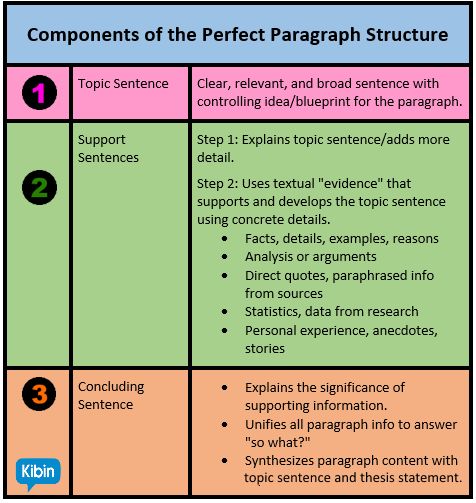
The topic sentence, often appearing as the initial sentence of a paragraph, explicitly states the main idea being explored. It serves as a roadmap for the reader, signaling what to expect in the following sentences. A strong topic sentence is concise, direct, and clearly linked to the thesis statement.


Consider the following topic sentence: "Global warming, caused primarily by anthropogenic greenhouse gas emissions, has Catalonia. This sentence directly links to the thesis statement and serves as a clear signal to the reader about the idea that will be explored in the paragraph.
Supporting Sentences
Supporting sentences follow the topic sentence, providing detail, evidence, or analysis related to the main idea. They are crucial for developing the idea and offering depth to your arguments. These sentences should link back to the topic sentence, demonstrating how they support or elaborate on the main idea.
For instance, continuing with our previous example: "Over the past century, glacial retreat in the Pyrenees has accelerated significantly, with numerous smaller glaciers disappearing entirely." This sentence supports the topic sentence by providing a specific example of global warming's effects on Catalonia.


The Coherence and Cohesion of an Academic Paragraph
Coherence and cohesion are vital aspects of academic paragraph structure, facilitating smooth flow and understanding for the reader. They ensure that each paragraph is a logical progression from the last, maintaining a clear and consistent train of thought.
Coherence refers to the logical flow of ideas, making sure that each idea follows naturally from the previous one. Cohesion, on the other hand, relates to textual connection - using language that links ideas together, creating a seamless flow from one sentence to the next.
Transitions
Transitions are essential for maintaining cohesion and coherence. They help guide the reader through the text, signaling how ideas relate to one another. Transition words and phrases should be used judiciously to create smooth connections between sentences and paragraphs.

For example, using transition phrases like "moreover," "furthermore," for adding points, or "despite this," "however," for contrasting ideas, can greatly improve the flow of your writing.
Conclusion
The final sentence of a paragraph often summarizes the main idea, reinforcing its significance and bringing the paragraph to a close. This is a crucial juncture where you can emphasize the relevance of your point to the broader argument or thesis.
It could also serve as a gentle bridge to the next paragraph, hinting at the subsequent idea to be explored. However, it's essential not to use clichéd phrases like "In conclusion" or "Furthermore"; let the structure of your paragraphs speak for themselves.
Injecting your writing with academic paragraph structure enhances its clarity, cohesion, and persuasiveness. It is a skill that separates compelling scholarly work from mediocre writing. Developing proficiently takes time and practice, so keep refining your paragraphs, and you'll soon reap the worthwhile rewards of academic distinction.
Related Articles

Understanding Academic Structure: A Comprehensive Guide
The term 'structure' in academic writing often seems ambiguous, but it's a cornerstone of clear, persuasive, and credible research. Let's delve into what it...
Academic Paragraph Structure: PDF Guide
Crafting a well-structured academic paragraph is a cornerstone of effective writing, especially when it comes to research papers, essays, and other scholarly...

Essential Essay Structure: A Comprehensive Guide for Academic Writing
Crafting an academic essay is an intricate process that requires careful planning and structuring. The essence of this task lies in communicating your ideas...

"Car Accident Lawsuit Process: Step-by-Step Guide"
If you've been involved in a car accident, you might be wondering what the process of a car accident lawsuit entails. Navigating the legal system can seem...

Mastering Resignations: A Step-by-Step Guide on What to Write When an Employee Resigns
Receiving an employee resignation letter can be an emotional and stressful experience for any business owner or HR professional. It's crucial to handle this...

How to Calculate Circle Surface Area: Formula & Step-by-Step Guide
Ever wondered how to calculate the extent of a circle's border? The surface area of a circle might seem like a more straightforward calculation, but today...